
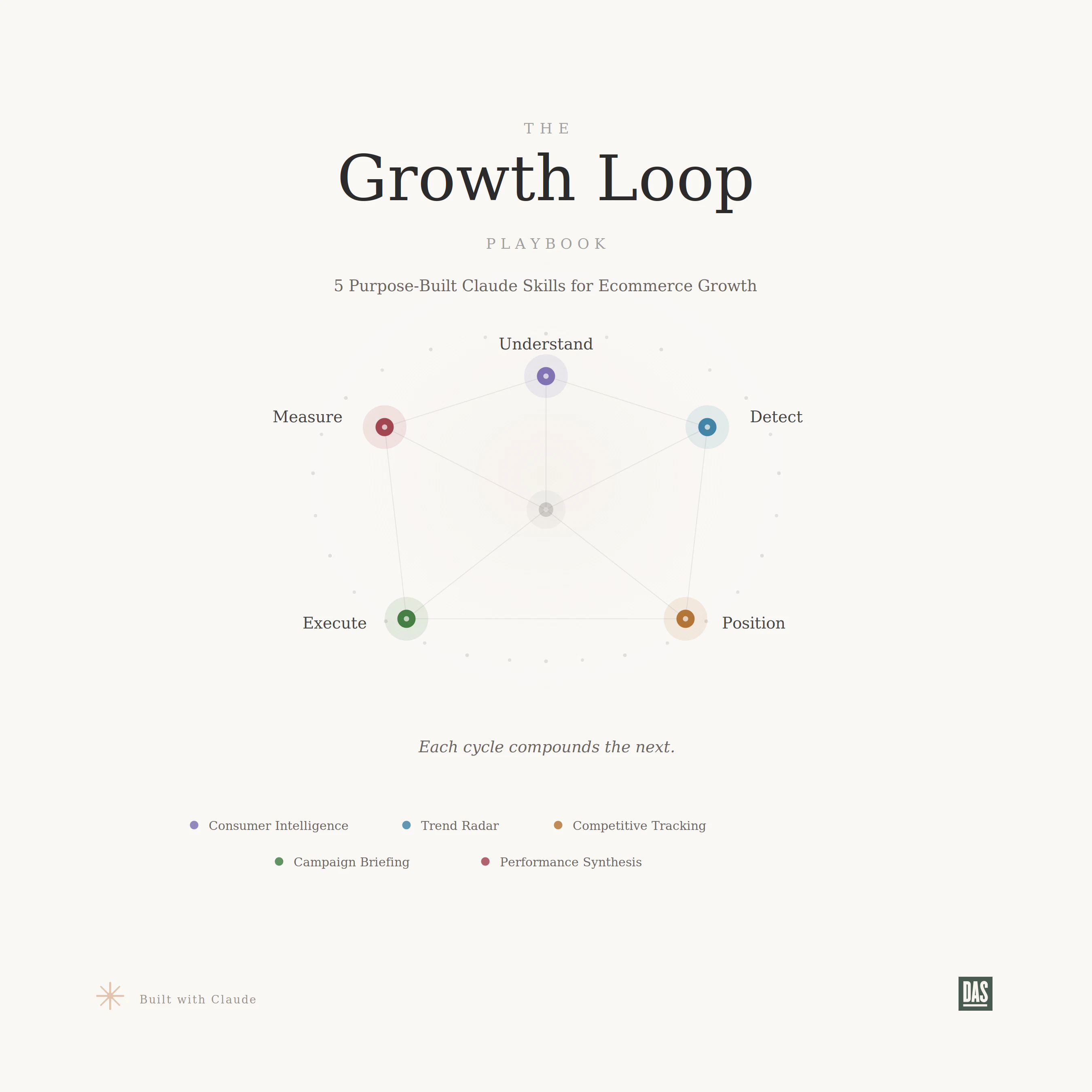
5 Purpose-Built Claude Skills for the Ecommerce Growth Operating Loop
Notion_Cover_Square.png Your growth team runs five workflows every week — review mining, trend detection, competitive tracking, campaign briefing, performance synthesis. These five workflows consume 60–80% of your strategic bandwidth. And at most brands, every single one of them is manual. This playbook gives you a Claude Skill for each stage of the loop. Install them. Run the loop. Let the efficiencies compound.

Quick Start: Download These Skills

For those who prefer diving into the deep end, you can get started by downloading the skills. Each file is a .md skill you upload to Claude, and they begin to work immediately; no setup, no code, no API keys. For best results, also upload a Brand Brain document (template included below).

Download All 5 Skills

SkillWhat It Does
Consumer Intelligence EngineMines reviews and feedback for messaging insights, ad copy angles, and objection frameworks
Trend RadarDetects and scores emerging category signals across 6 platforms
Competitive Position TrackerAnalyzes competitor pricing, creative, messaging, and finds whitespace
Campaign Brief ArchitectGenerates complete omnichannel creative briefs from your intelligence
Performance Command CenterTurns weekly metrics into narrative intelligence and prioritized action lists

3-step install

  1. Download the .zip file(s) above
  2. Upload to Claude: go to Customize → Skills → upload the .zip
  3. Ask Claude anything relevant — the skill activates automatically
That is it. Claude detects when a skill applies and loads it behind the scenes. No slash commands, no prompting tricks. You describe what you need, the skill brings the methodology.
Want these skills customized for your brand — with your competitors, your products, your channel mix pre-loaded? That is what DAS builds. Reach out: amlan@madebydas.com

The Problem Nobody’s Solving

Every scaling ecommerce brand runs the following five workflows:
  • They mine customer reviews for messaging insights.
    • Review-mining means exporting CSVs from your primary online storefront, social storefronts, marketplaces, retail, affiliate, etc., then pasting them into spreadsheets, and spending hours tagging themes by hand.
  • They scan the market for emerging trends.
    • Trend detection means scrolling TikTok and hoping something clicks or scouring Google trends and Reddit for insights.
  • They track what competitors are doing.
    • Competitive intelligence means checking the Meta Ad Library when someone remembers to.
  • They brief creative for campaigns.
    • Campaign briefing means a Slack thread with a few bullet points that the creative team has to interpret.
  • And they synthesize performance data into decisions about what to do next.
    • Meaning, pulling reports from six dashboards, copy-pasting into a deck, and presenting numbers without clear next steps.
These five workflows consume 60–80% of a growth team’s strategic bandwidth. And at most brands, each workflow is happening manually. The cost is not measured in dollars. It is measured in speed. The brands winning right now have compressed this loop from weeks to hours. They are not smarter. They are not better funded. They have simply automated the connective tissue between insight and action. The signal that used to take two weeks to travel from a customer review to an ad-headline now takes an afternoon. The tools exist. 89% of retail and ecommerce companies are testing AI in some capacity. But only 7–26% have piloted deployments. The gap between belief and execution is enormous—and it is almost entirely an implementation problem, not a technology problem. The barrier is not skepticism. 98% of mid-market marketers believe AI will improve their effectiveness. The barriers are skill gaps, integration challenges, and not knowing where to start. Generic AI tools produce generic output. And the ecommerce-specific AI tooling that exists is either prohibitively expensive or disconnected from the workflows that actually drive growth. This playbook closes that gap with five purpose-built Claude Skills—one for each stage of the Growth Operating Loop—that a growth team can install and start using today.

The Growth Operating Loop

The five workflows are not independent tasks. They are stages in a continuous cycle that compounds over time. We call this the Growth Operating Loop. The_Growth_Loop_Diagram.png Each stage maps to one skill:
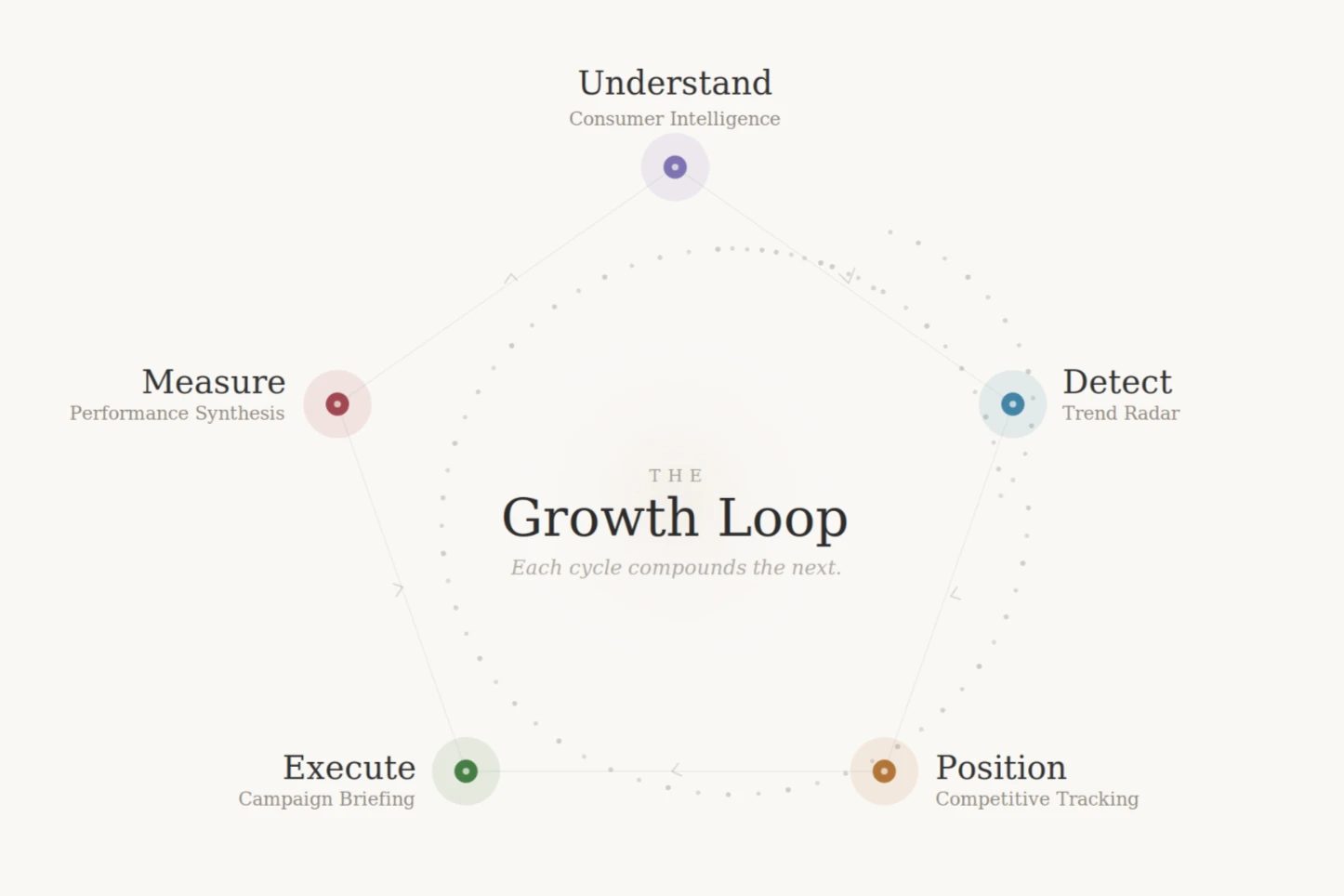
  1. Understand → Consumer Intelligence Engine. Mine reviews, support tickets, and social conversations to extract what customers actually say, want, and object to.
  2. Detect → Trend Radar. Identify category signals accelerating across platforms before competitors see them. Classify by durability. Score by opportunity.
  3. Position → Competitive Position Tracker. Monitor competitor pricing, ad creative, messaging, and product launches. Map where you stand. Find the whitespace.
  4. Execute → Campaign Brief Architect. Transform insights from the first three skills into structured, channel-specific creative briefs your team can immediately act on.
  5. Measure → Performance Command Center. Synthesize cross-channel performance data into narrative intelligence that closes the gap between what happened and what to do next.
The compounding effect is the point; each cycle through the loop makes the next cycle sharper: → Consumer intelligence informs trend detection → Trend detection shapes competitive positioning → Competitive positioning drives campaign briefs → Campaign performance feeds back into consumer intelligence A brand running this loop manually completes it once per quarter, maybe. A brand running it with these five skills completes it weekly. Over a year, that is 52 cycles of compounding intelligence versus 4. The gap in market responsiveness becomes insurmountable. The rest of this playbook gives you everything you need to install and run the full loop.

What Are Claude Skills (And Why They Matter)

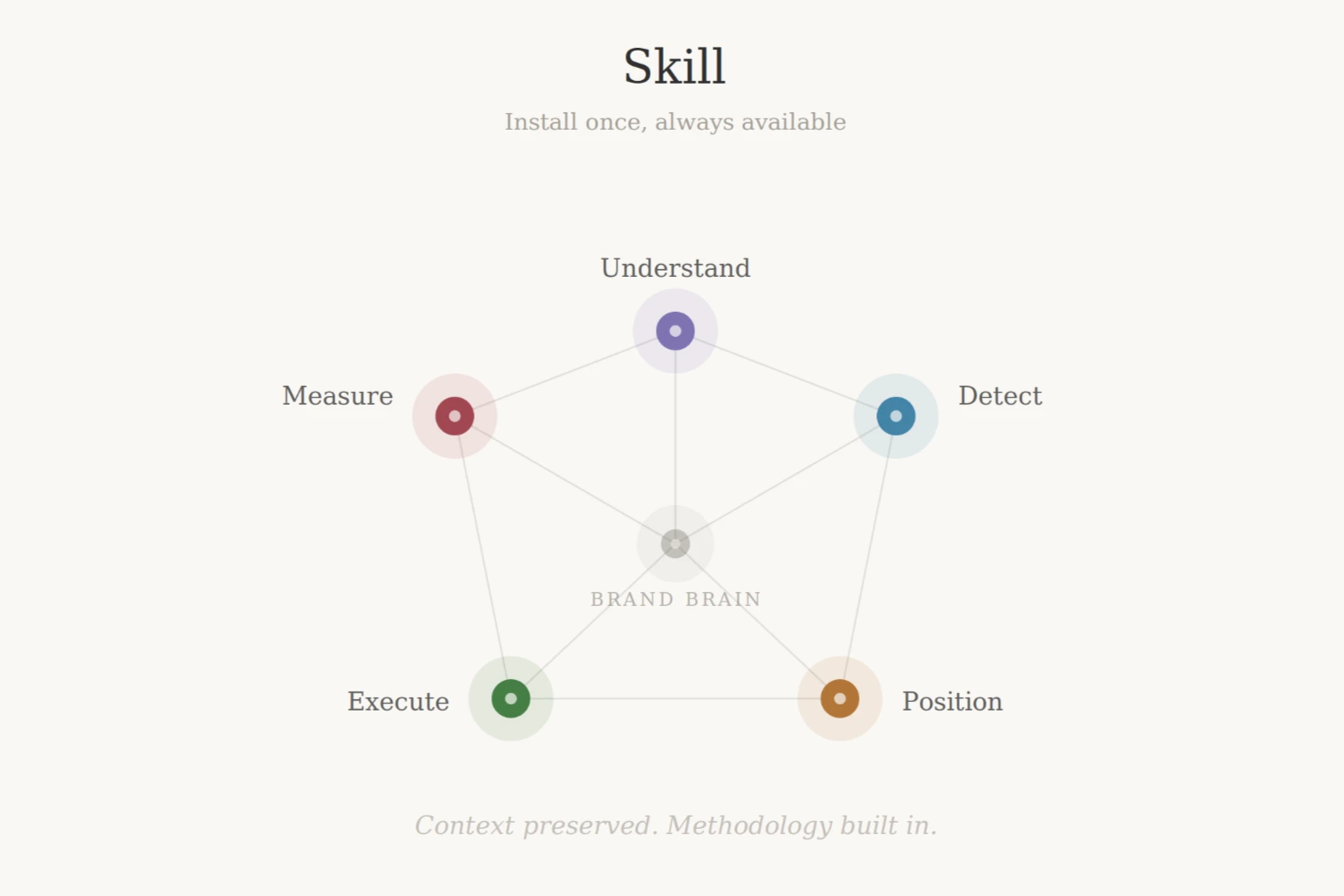
If you have used Claude before, you have used prompts; the one-off instructions that disappear when the conversation ends. Every new session, you start from zero. You re-explain your brand, re-describe your audience, re-state your formatting preferences. Skill_Constellation_Diagram.png Claude Skills change this entirely. A Skill is a persistent, reusable set of instructions that Claude loads automatically whenever a relevant task is detected. Think of it as a trained specialist you hire once.
PromptSkill
PersistenceGone after conversationPermanent until removed
ContextYou provide every timePre-loaded automatically
TriggeringYou type the instructionClaude detects relevance
Output qualityVaries with prompt qualityConsistent methodology
Brand awarenessOnly what you paste inReads from Brand Brain
ReusabilityCopy-paste between sessionsInstall once, use forever

How to Install a Skill

  1. Enable Skills. In Claude, go to Settings → Capabilities → toggle on Code execution and file creation. Then go to Customize → Skills.
  2. Upload the Skill file. Download the .zip from the Quick Start section above. Upload it in Customize → Skills.
  3. Verify activation. Ask Claude: “What skills are available?” You should see the skill listed.
  4. Upload your Brand Brain. For best results, also upload the Brand Brain document (template below) as a Project file or directly in your conversation.
Skills work across Claude.ai (web and mobile), Claude Code (command line), and Claude Cowork (autonomous agent mode). Available on Free, Pro, Max, Team, and Enterprise plans.

Setting Up Your Brand Brain

Every skill in this playbook references a shared Brand Brain—a single context document that captures everything Claude needs to produce output that sounds like your brand, understands your market, and speaks to your specific customer. Without a Brand Brain, these skills produce good output. With a Brand Brain, they produce YOUR output.

The Essential Sections

Your Brand Brain does not need to be exhaustive on day one. Start with these six sections and expand over time. 1. Brand Voice and Tone How your brand sounds. Include 3–5 adjectives that describe your tone, examples of on-brand and off-brand language, words or phrases you always or never use, and reading level. 2. Target Personas Go beyond demographics. Include psychographic drivers: why they buy, what they fear, what outcome they are really purchasing, what language they use to describe their problem (pull directly from Skill 1 outputs), and what objections they raise. 3. Product Catalog Core products with key proof points. For each: one-sentence positioning, primary and secondary benefits, price point, top customer-cited reasons for purchasing, and compliance guardrails. 4. Competitive Set Top 3–5 direct competitors: their positioning, pricing relative to yours, messaging themes, and specific reasons a customer chooses you over them (and vice versa). Feeds directly into Skill 3. 5. Channel Mix and Priorities Primary sales channels (Shopify, Amazon, Walmart, retail), marketing channels ranked by investment, current budget allocation, and KPI targets by channel. Feeds Skills 4 and 5. 6. Key Metrics and Targets Revenue targets, MER target, CAC ceiling, ROAS thresholds by channel, conversion rate benchmarks, email/SMS revenue contribution targets.
Building a comprehensive Brand Brain takes weeks of focused work to do well. DAS builds custom Brand Brains for scaling ecommerce brands — including competitive research, persona development, and channel strategy mapping — as part of our AI workflow implementation engagements. Reach out: amlan@madebydas.com

Skill 1: Consumer Intelligence Engine

Understand what your customers actually say, want, and object to. Skill1_Consumer_Intelligence_Diagram.png
Download consumer-intelligence-engine.md file

The Problem

Your brand has thousands of reviews scattered across Shopify, Amazon, Trustpilot, Reddit, and social media. Individually, each review is anecdotal. Together, they contain your entire messaging strategy, written in the exact language your customers use. The problem is synthesis. Most brands either ignore this data entirely or run it through generic sentiment tools that classify everything as “positive” or “negative” without extracting anything actionable. A skincare brand scraping 10,000 Amazon reviews found their AI tools frequently misclassified sentiment because they did not understand terms like “texture,” “absorption,” or “glow.” The output said 72% positive. The team still had no idea what to do. Practitioners who do this well report 40–70% conversion rate increases simply by replacing internal marketing language with phrases extracted directly from customer conversations. One wellness brand discovered users described their pre-product state as “feeling scattered and overwhelmed” and their desired outcome as “finally being able to take a full breath.” After rebuilding messaging around these exact phrases, trial-to-paid conversion jumped 32% and CAC dropped nearly 50%. The words your customers use to describe their problem are your headline copy. This skill extracts them systematically.

The Workflow

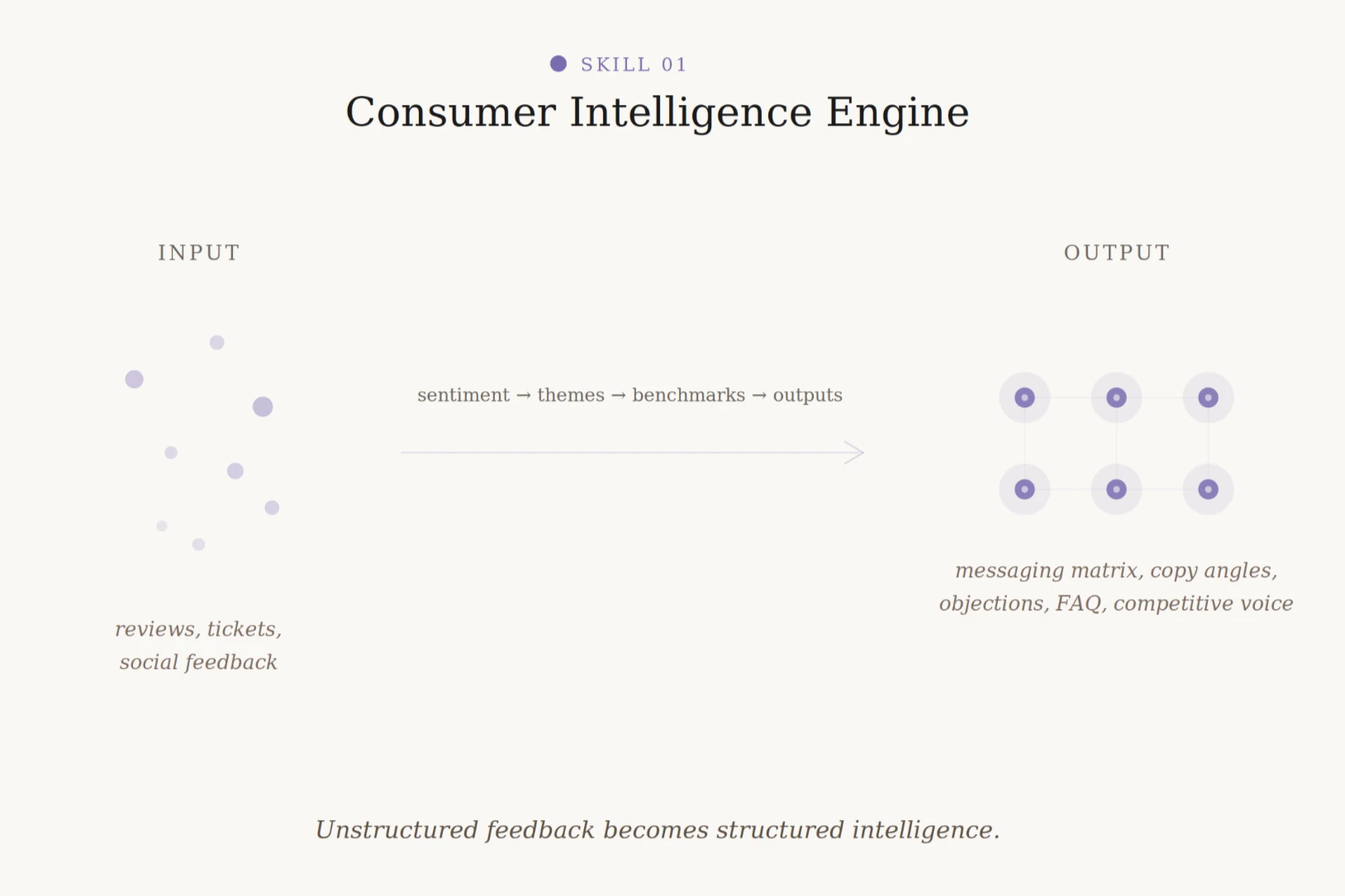
The Consumer Intelligence Engine runs a four-layer analysis on any set of customer reviews or feedback data:
┌──────────────────────────────────────────────────────────────┐
│                 CONSUMER INTELLIGENCE ENGINE                  │
│                                                              │
│  INPUT: Reviews, support tickets, social feedback            │
│  ─────────────────────────────────────────────               │
│                                                              │
│  Layer 1 ─── Aspect-Level Sentiment                          │
│              (packaging: neg | taste: pos | price: neutral)  │
│                        │                                     │
│  Layer 2 ─── Theme Extraction                                │
│              (2-3 verbatim quotes per theme)                 │
│                        │                                     │
│  Layer 3 ─── Competitive Benchmarking                        │
│              (side-by-side sentiment vs. competitors)        │
│                        │                                     │
│  Layer 4 ─── Actionable Output Generation                    │
│              6 deliverables (see below)                      │
│                                                              │
│  ─────────────────────────────────────────────               │
│  OUTPUT:                                                     │
│  ✓ Messaging Matrix      ✓ Ad Copy Angle Library             │
│  ✓ Product Feedback List  ✓ FAQ Content Map                  │
│  ✓ Objection Framework    ✓ Competitive Voice Comparison     │
└──────────────────────────────────────────────────────────────┘
  • Layer 1 — Aspect-Level Sentiment. Classifies sentiment at the feature level (packaging: negative; taste: positive; price: neutral) rather than just overall polarity. This surfaces the specific product dimensions driving satisfaction and dissatisfaction.
  • Layer 2 — Theme Extraction. Identifies recurring themes using topic modeling with frequency analysis. Extracts 2–3 direct verbatim quotes per theme to preserve authentic customer language. Groups themes by: pain points described, desired outcomes, product-specific feedback, and purchase triggers.
  • Layer 3 — Competitive Benchmarking. Compares sentiment patterns against your top competitors (using reviews from the same platforms). Identifies where you outperform, where you underperform, and where customers are making direct comparisons.
  • Layer 4 — Actionable Output Generation. Produces six deliverables: a messaging matrix mapping customer language to marketing copy angles, an ad copy angle library organized by theme, a product feedback priority list ranked by frequency multiplied by severity, an FAQ content map, an objection handling framework, and a competitive voice comparison.

The SKILL.md

Below is the complete skill code. Placeholders marked with [CUSTOMIZE] should be replaced with your brand-specific information, ideally pulled from your Brand Brain document. The skill is designed to work immediately with reasonable defaults, but customization dramatically improves output quality.
---
name: consumer-intelligence-engine
description: >
  Analyzes customer reviews, support tickets, and social feedback to
  extract messaging insights, sentiment patterns, and voice-of-customer
  intelligence for ecommerce brands. Use when asked to analyze reviews,
  mine customer language, build messaging matrices, or extract VOC data.
---

# Consumer Intelligence Engine

## Context
You are a senior consumer research analyst specializing in ecommerce
and retail brands. You extract actionable messaging intelligence from
customer feedback data — not summaries, not sentiment scores, but the
specific language, themes, and patterns that drive conversion.

Read the Brand Brain document for brand context, competitive set, and
target personas before beginning analysis.

## Input Handling
Accept review data in any format:
- CSV exports from Shopify (Yotpo, Judge.me, Okendo, Stamped)
- Amazon review dumps (from Helium 10, Jungle Scout, or manual copy)
- Pasted text from Trustpilot, Reddit, social comments
- Support ticket exports from Gorgias, Zendesk, or Kustomer

If data includes star ratings, use them. If not, infer sentiment from
language. Flag when sample size is below 50 reviews per product.

## Analysis Framework

### Layer 1: Aspect-Level Sentiment
For each product or product category in the data:
- Identify the top 8-12 aspects customers mention (ex: taste,
  texture, packaging, price, effectiveness, shipping, scent)
- Classify each mention as positive, negative, or neutral
- Calculate aspect-level sentiment ratios
- Flag aspects with >30% negative sentiment as priority issues
- [CUSTOMIZE: Add your product-specific aspects here]

### Layer 2: Theme Extraction
Group feedback into themes. For each theme:
- Name the theme in plain language (not jargon)
- Provide frequency count or proportional indicator
- Extract 2-3 VERBATIM quotes that best represent the theme
- Classify as: Pain Point | Desired Outcome | Product Feedback |
  Purchase Trigger | Objection | Competitor Comparison
- NEVER fabricate quotes or frequency counts. Use ranges if unsure.

### Layer 3: Competitive Benchmarking
If competitor review data is provided or referenced:
- Compare aspect-level sentiment across brands
- Identify aspects where you outperform competitors
- Identify aspects where competitors outperform you
- Note where customers make explicit brand comparisons
- [CUSTOMIZE: Your competitive set from Brand Brain]

### Layer 4: Deliverables
Generate ALL of the following:

**1. Messaging Matrix**
| Customer Language | Pain Point | Desired Outcome | Copy Angle |
Map exact customer phrases to the marketing message they suggest.

**2. Ad Copy Angle Library**
Organize verbatim phrases by theme. Each angle includes: the
customer quote, the implied benefit, and a suggested headline.

**3. Product Feedback Priorities**
Ranked list: frequency x sentiment severity. Top 5 issues with
specific customer quotes and recommended actions.

**4. FAQ Content Map**
Questions customers are asking (explicitly or implicitly) mapped
to recommended answers using voice-of-customer language.

**5. Objection Handling Framework**
Top 5-8 objections with: the objection in customer language, the
underlying concern, the counter-argument, and proof points.

**6. Competitive Voice Comparison** (if data available)
Side-by-side: how your customers describe you vs. how competitor
customers describe them. Focus on language differences.

## Output Format
Structure output with clear headers for each deliverable.
Use tables where they aid readability.
Always lead with the Messaging Matrix — it is the highest-value output.
Include a 3-sentence executive summary at the top.

## Guardrails
- Never hallucinate frequency data. If counts are uncertain, say so.
- Never invent quotes. Every quoted phrase must appear in the source.
- Flag sample sizes below statistical significance.
- Note if data skews toward one sentiment (e.g., only 1-star reviews).
- [CUSTOMIZE: Add any brand-specific compliance guardrails]

See It Work: Sample Output

Here is what the Messaging Matrix output looks like for a hypothetical wellness supplement brand analyzing 2,400 Amazon reviews:
EXECUTIVE SUMMARY: Customers consistently describe their pre-purchase state using language centered on energy and mental fog, not ingredient-specific terms. The strongest purchase trigger is peer recommendation from specific communities (fitness, new mothers). The primary objection is price relative to grocery-store alternatives. MESSAGING MATRIX (Top 5 of 18 angles identified)
┌────────────────────────────────────┬──────────────────────┬────────────────────────┬───────────────────────────────┐
│ Customer Language                  │ Pain Point           │ Desired Outcome        │ Copy Angle                    │
├────────────────────────────────────┼──────────────────────┼────────────────────────┼───────────────────────────────┤
│ "I was tired of feeling foggy      │ Afternoon energy     │ Sustained mental       │ "The 2pm fog, gone."          │
│  by 2pm"                           │ crash                │ clarity                │                               │
├────────────────────────────────────┼──────────────────────┼────────────────────────┼───────────────────────────────┤
│ "My trainer recommended it and     │ Skepticism from past │ Credible recommendation│ "The supplement your trainer  │
│  I actually noticed a difference"  │ supplements          │ + felt result          │  actually uses."              │
├────────────────────────────────────┼──────────────────────┼────────────────────────┼───────────────────────────────┤
│ "It's expensive but I stopped      │ Cost justification   │ Consolidation /        │ "Replace your cabinet.        │
│  buying three other things"        │                      │ simplification         │  One product."                │
├────────────────────────────────────┼──────────────────────┼────────────────────────┼───────────────────────────────┤
│ "Finally something that doesn't    │ Taste/texture        │ Enjoyable daily        │ "Wellness that doesn't taste  │
│  taste like chalk"                 │ aversion             │ routine                │  like a punishment."          │
├────────────────────────────────────┼──────────────────────┼────────────────────────┼───────────────────────────────┤
│ "I was skeptical but my wife       │ Trust barrier        │ Social validation      │ "Don't take our word for it.  │
│  convinced me to try it"           │                      │                        │  Take hers."                  │
└────────────────────────────────────┴──────────────────────┴────────────────────────┴───────────────────────────────┘
[…continues for all 18 angles across 6 deliverables]

Customization Notes

  • Vertical adaptation: Replace aspect categories for your product type. A fashion brand analyzes fit, fabric quality, and sizing accuracy. A pet brand analyzes palatability, ingredient sourcing, and pet reaction. The analysis framework is identical — only the aspects change.
  • Data source tips: Amazon reviews are highest volume. Shopify reviews tend to skew more positive (customers already committed). Reddit and social comments contain the rawest, most unfiltered language. The best analyses combine all three.
  • Frequency: Run this monthly at minimum. Run it immediately after a product launch, a major promotion, or a negative PR event. The messaging matrix should be a living document your content team references weekly.
Want this built for your brand? DAS builds custom Consumer Intelligence Engines with pre-mapped aspect taxonomies for your product category, automated data ingestion templates, and integration with your review management platform. → amlan@madebydas.com

Skill 2: Trend Radar

Spot what is accelerating in your category before your competitors do. Skill2_Trend_Radar_Diagram.png
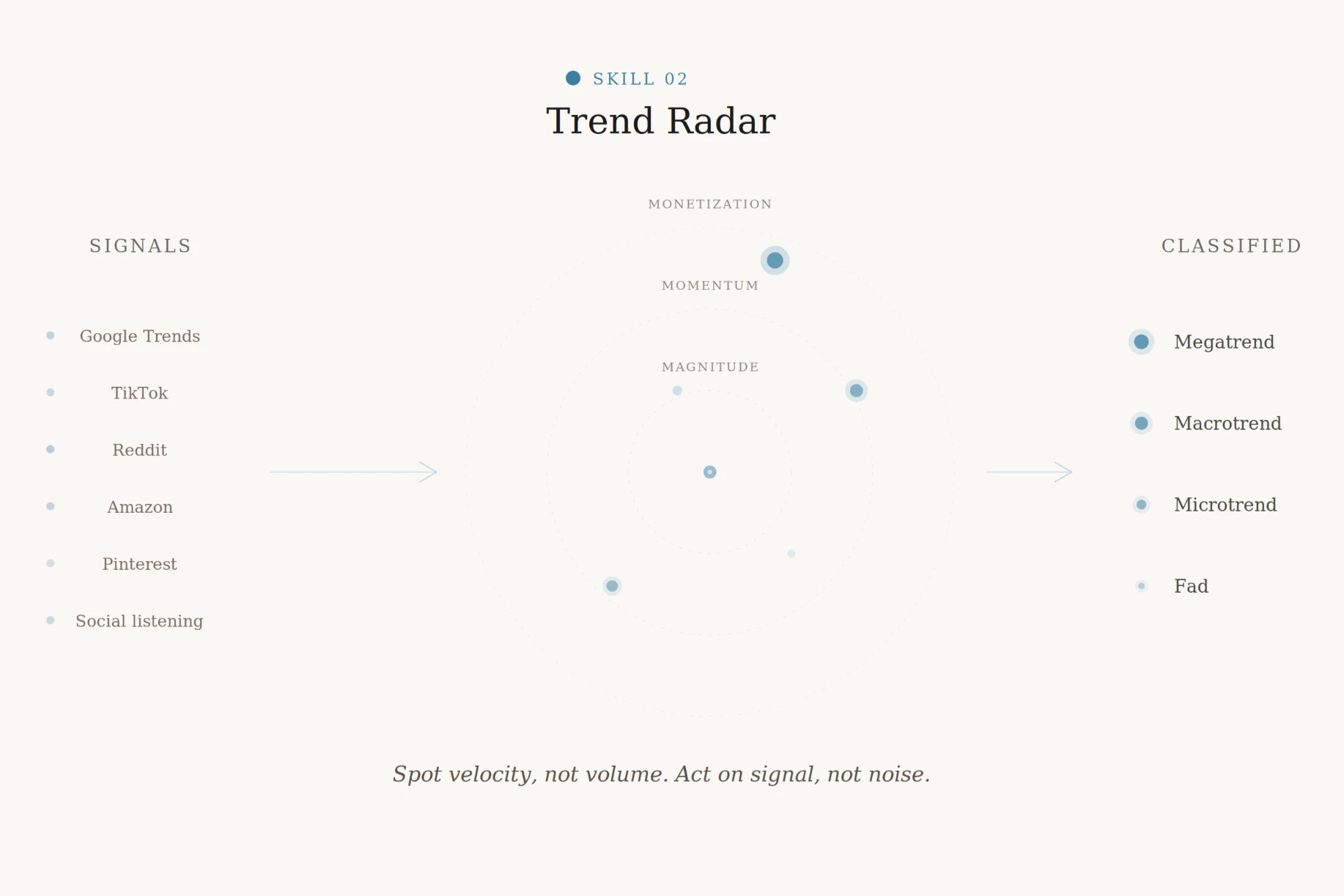
↑ Download trend-radar.md file

The Problem

Trend forecasting for ecommerce brands operates on two tracks:
  1. Long-range planning (12–24 months) draws on trend-forecasting agencies like WGSN and Mintel for macro cultural shifts.
  2. Near-term intelligence (6–12 months) requires real-time signal tools like Spate, which analyzes 900 billion Google search signals and 200 million social posts with 72% accuracy on 12-month predictions.
Most brands aren’t actively investing in either track. So they rely on gut feel, whatever the founder saw on TikTok last weekend, or trend reports that are already six months stale by the time they reach the team. The result is predictable. Brands either chase trends too late (the “everyone is doing it” phase where there is no differentiation) or invest in trends too early without validation (the “we were ahead of our time” phase that burns budget). The brands that appear prescient are not clairvoyant. They have a signal detection system that distinguishes velocity from noise. This skill gives you that system. It does not replace a WGSN subscription for 24-month macro planning. It replaces the ad hoc, manual scanning that most teams do for 1–12 month planning — which is where the majority of campaign and content decisions actually happen.

The Workflow

┌──────────────────────────────────────────────────────────────┐
│                        TREND RADAR                            │
│                                                              │
│  INPUT: Google Trends, TikTok, Reddit, Amazon,               │
│         Pinterest, social listening data                      │
│  ─────────────────────────────────────────────               │
│                                                              │
│  Step 1 ─── Signal Detection                                 │
│             (identify accelerating patterns)                 │
│                        │                                     │
│  Step 2 ─── Cross-Platform Validation                        │
│             1 platform = noise │ 3+ = validated              │
│                        │                                     │
│  Step 3 ─── Opportunity Scoring                              │
│             Magnitude × Momentum × Monetization              │
│             (1-5 each, max composite: 125)                   │
│                        │                                     │
│  Step 4 ─── Trend Classification                             │
│             Megatrend│Macrotrend│Microtrend│Fad              │
│                        │                                     │
│  Step 5 ─── Risk Assessment + Action Recommendation          │
│                                                              │
│  ─────────────────────────────────────────────               │
│  OUTPUT: Scored + classified Trend Brief                      │
│          with specific action recs per signal                │
└──────────────────────────────────────────────────────────────┘
  • Signal Detection. Accepts data from Google Trends, TikTok Creative Center, Reddit threads, Amazon search term reports, Pinterest Trends, and social listening exports. Identifies signals that are accelerating — not just popular, but gaining speed.
  • Cross-Platform Validation. A signal appearing on one platform is noise. A signal appearing on three platforms is a pattern. The skill cross-references signals across sources and assigns a validation score based on platform diversity.
  • Opportunity Scoring. Each validated signal is scored on three dimensions: Magnitude (how many consumers care deeply), Momentum (growth rate and trajectory), and Monetization (willingness to pay a premium). These multiply into a composite opportunity score.
  • Trend Classification. Signals are classified into four tiers: Megatrend (10+ years, foundational bets), Macrotrend (3–10 years, R&D and product line investments), Microtrend (6 months to 3 years, content and limited-edition plays), and Fad (days to weeks, social content only — never invest in product development).
  • Action Recommendation. Each classified trend receives a specific recommended action: ignore, create content, launch limited-edition SKU, brief R&D, or adjust positioning.

The SKILL.md

---
name: trend-radar
description: >
  Detects and validates emerging trends in ecommerce categories by
  analyzing signals across Google Trends, TikTok, Reddit, Amazon,
  Pinterest, and social platforms. Classifies trends by durability and
  scores them by commercial opportunity. Use when asked about trends,
  emerging categories, what is gaining traction, or market signals.
---

# Trend Radar

## Context
You are a trend intelligence analyst for ecommerce brands. Your job
is not to identify what is popular — it is to identify what is
ACCELERATING and assess whether it represents a durable commercial
opportunity or a temporary spike.

Read the Brand Brain for: product category, competitive set, current
positioning, and the specific sub-categories or ingredients relevant
to this brand.

## Input Handling
Accept trend data in any combination of:
- Google Trends exports or described patterns
- TikTok Creative Center data or described observations
- Reddit thread summaries or links
- Amazon Search Term reports (from Brand Analytics or Helium 10)
- Pinterest Trends data or Pinterest Predicts references
- Social listening exports (Brandwatch, Sprout, Meltwater)
- Freeform descriptions of observed signals

If web search is available, supplement provided data with current
search to validate signals. If not, work with provided data only
and note where additional validation would strengthen conclusions.

## Analysis Framework

### Step 1: Signal Extraction
From provided data, identify distinct signals. A signal is:
- A specific topic, ingredient, format, aesthetic, or behavior
- That shows measurable acceleration (not just presence)
- Within the brand's category or adjacent categories
For each signal, note: source platform, acceleration evidence,
approximate timeline of emergence, and consumer segment driving it.
- [CUSTOMIZE: Your category keywords and sub-categories]

### Step 2: Cross-Platform Validation
For each signal, check (or ask) if it appears across platforms:
- 1 platform = Unvalidated (note, do not act)
- 2 platforms = Emerging (monitor weekly)
- 3+ platforms = Validated (evaluate for action)
Assign validation score: Low / Medium / High

### Step 3: Opportunity Scoring
Score each validated signal on three dimensions (1-5 scale):

MAGNITUDE: How many consumers care?
  1 = Niche community (<10K active participants)
  3 = Growing segment (100K-1M active participants)
  5 = Mass market (1M+ active participants)

MOMENTUM: How fast is it growing?
  1 = Stable/flat interest
  3 = 20-50% growth in search/mention volume over 90 days
  5 = 100%+ growth, viral acceleration

MONETIZATION: Will they pay?
  1 = Interest only, no purchase intent signals
  3 = Active product searching, comparison shopping
  5 = Existing premium pricing, strong willingness to pay

COMPOSITE SCORE = Magnitude x Momentum x Monetization (max 125)

### Step 4: Trend Classification
Based on evidence pattern, classify each signal:

MEGATREND (10+ years) — Foundational shift in consumer behavior.
  Action: Inform long-term product strategy and brand positioning.
  Example: Personalized nutrition, AI-assisted shopping.

MACROTREND (3-10 years) — Established and growing category shift.
  Action: R&D investment, product line extension, hiring.
  Example: Functional mushrooms in wellness, clean beauty.

MICROTREND (6 months - 3 years) — Specific and actionable now.
  Action: Content plays, limited-edition SKUs, campaign angles.
  Example: Specific ingredient spikes, aesthetic movements.

FAD (days - weeks) — Viral but not durable.
  Action: Social content ONLY. Never invest in product development.
  Example: Viral TikTok challenges, meme-driven interest spikes.

### Step 5: Risk Assessment
For each high-scoring signal, note potential risks:
- Regulatory exposure (FDA, FTC claims)
- Supply chain constraints
- Backlash potential (cultural sensitivity, greenwashing)
- Competitive saturation risk (how many brands already here?)
- [CUSTOMIZE: Industry-specific risk factors]

## Output Format
Structure as a TREND BRIEF with:

1. Executive Summary (3 sentences: biggest opportunity, biggest
   risk, recommended immediate action)
2. Trend Dashboard table:
   | Signal | Platforms | Validation | M x M x M | Class | Action |
3. Deep Dive on top 3 signals (one paragraph each with evidence)
4. Whitespace Opportunities (where NO competitor is playing yet)
5. Watch List (unvalidated signals to monitor next cycle)

## Guardrails
- Never conflate popularity with acceleration.
- Never classify a fad as a macrotrend to sound optimistic.
- Always note when data is insufficient for confident classification.
- Include at least one contrarian call: a popular signal you believe
  is DECLINING or at risk of backlash.

See It Work: Sample Output

Here is a condensed Trend Brief output for a functional beverage brand analyzing Q1 2026 signals:
EXECUTIVE SUMMARY: Magnesium-based relaxation products show the strongest acceleration this quarter (composite score: 100/125) with validated signals across TikTok, Reddit, Google Search, and Amazon. The “cortisol conscious” movement represents a macrotrend reframing stress management from mental health to hormonal optimization. Recommend: launch a magnesium SKU brief within 30 days and create 5 content pieces around cortisol education this week. TREND DASHBOARD (Top 5 of 12 signals analyzed)
┌─────────────────────┬───────────┬────────────┬───────┬───────────┬──────────────────┐
│ Signal              │ Platforms │ Validation │ Score │ Class     │ Action           │
├─────────────────────┼───────────┼────────────┼───────┼───────────┼──────────────────┤
│ Magnesium drinks    │ 4         │ High       │ 100   │ Macrotrend│ Product brief    │
│ Cortisol-conscious  │ 3         │ High       │ 75    │ Macrotrend│ Content series   │
│ Mushroom coffee     │ 2         │ Medium     │ 30    │ Fading    │ Reduce investment│
│ "Protein water"     │ 3         │ High       │ 60    │ Microtrend│ Limited SKU test │
│ "Sleepy girl        │ 1         │ Low        │ 15    │ Fad       │ Social only      │
│  mocktail"          │           │            │       │           │                  │
└─────────────────────┴───────────┴────────────┴───────┴───────────┴──────────────────┘
CONTRARIAN CALL: Mushroom coffee shows declining search velocity despite continued shelf space expansion. Early adopters have moved on. Brands still investing in this category face margin compression within 6 months.

Customization Notes

  • Vertical adaptation: For fashion brands, replace ingredient signals with aesthetic and material signals (ex: “quiet luxury” declining, “demure maximalism” accelerating). For home goods, track material trends, color palette shifts, and design movement signals. The scoring framework is universal.
  • Data sourcing tips: Google Trends is your baseline (free, quantitative). Reddit is your leading indicator (signals appear here 3–6 months before mainstream). TikTok shows velocity but inflates magnitude. Amazon Search Terms from Brand Analytics show commercial intent, which is the strongest monetization signal.
  • Frequency: Run monthly for ongoing category intelligence. Run immediately before product planning cycles, seasonal content planning, or investor presentations.
Want this built for your brand? DAS builds custom Trend Radars with automated signal feeds for your category, competitive tracking overlays, and integration with your product development calendar. → amlan@madebydas.com

Skill 3: Competitive Position Tracker

Know where you stand, what they are doing, and where the whitespace is. Skill3_Competitive_Position_Diagram.png
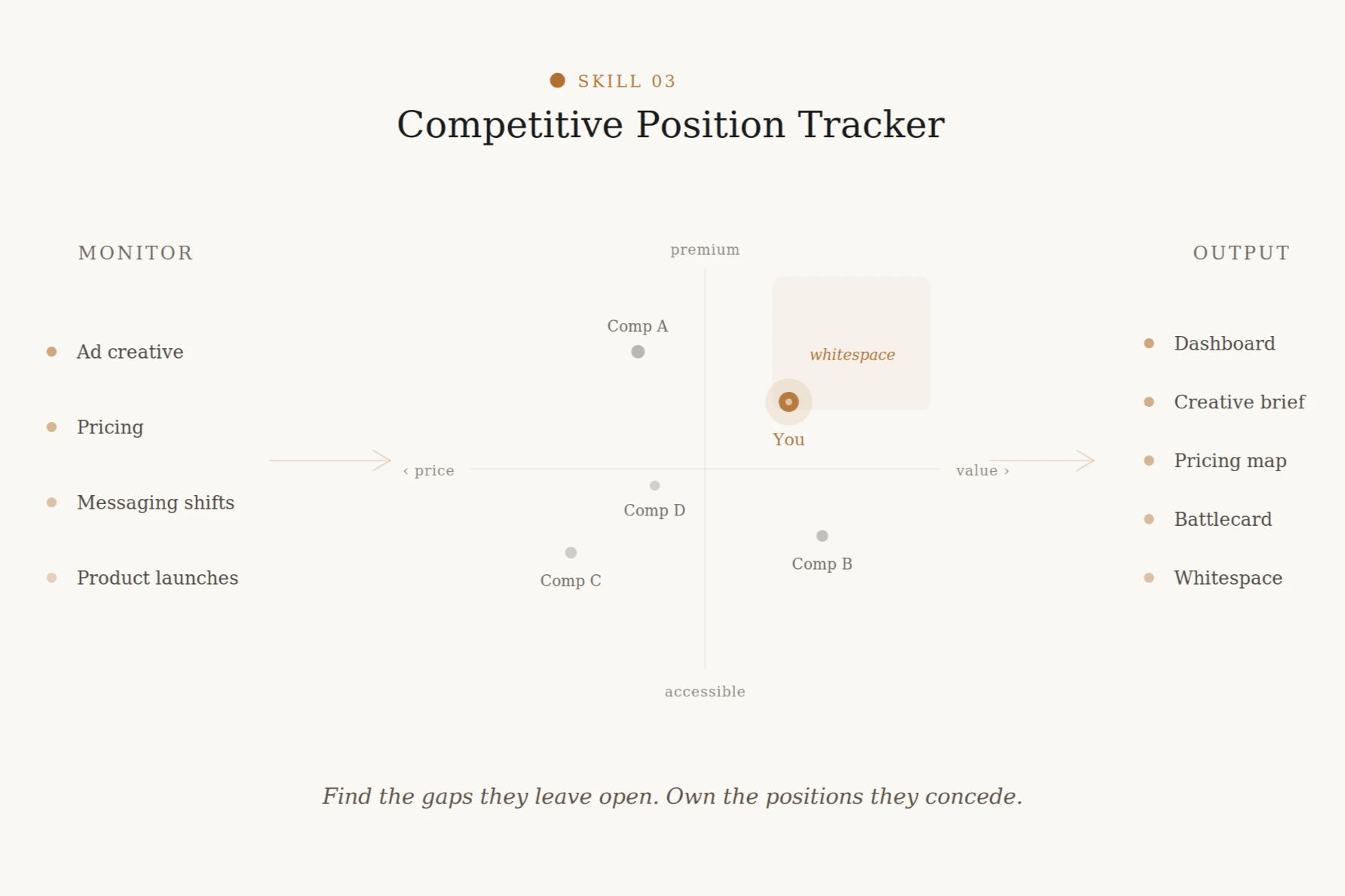
↑ Download competitive-position-tracker.md file

The Problem

Nearly 83% of ecommerce companies still track competitors using manual spreadsheet-based methods. 44% report having zero competitor visibility beyond sporadic checks. Meanwhile, the competitive intelligence software market is projected to reach $1.12 billion by 2032—evidence that brands know this matters, even if most have not solved it. The current tool landscape is fragmented and expensive. Pricing intelligence tools like Prisync cover price monitoring but miss messaging. Ad creative tools like Foreplay archive competitor ads but do not connect creative strategy to market positioning. Full-stack CI platforms like Klue are built for enterprise B2B, not ecommerce growth teams. The result is that competitive intelligence at most brands is reactive and incomplete. Someone checks the Meta Ad Library before a campaign launch. Someone notices a competitor’s price change on Amazon. But no one is systematically connecting pricing shifts to messaging changes to product launches to ad creative strategy. That connection is where the real intelligence lives. This skill creates a structured, repeatable competitive analysis workflow that connects all four dimensions and outputs actionable positioning intelligence.

The Workflow

┌──────────────────────────────────────────────────────────────┐
│                COMPETITIVE POSITION TRACKER                   │
│                                                              │
│  INPUT: Ad Library screenshots, pricing data, competitor     │
│         websites, email captures, Amazon listings             │
│  ─────────────────────────────────────────────               │
│                                                              │
│  Dimension 1 ─── Ad Creative Analysis                        │
│                  (theme, hook, visual, copy, format, intent) │
│                                                              │
│  Dimension 2 ─── Pricing Intelligence                        │
│                  (effective price incl. bundles/subs/shipping)│
│                                                              │
│  Dimension 3 ─── Messaging & Positioning Shifts              │
│                  (website, email, ads, social evolution)      │
│                                                              │
│  Dimension 4 ─── Whitespace Identification                   │
│                  (what NO competitor is doing)                │
│                                                              │
│  ─────────────────────────────────────────────               │
│  OUTPUT:                                                     │
│  ✓ Competitive Dashboard   ✓ Creative Strategy Brief         │
│  ✓ Pricing Position Map    ✓ Battlecard per competitor       │
│  ✓ Whitespace Opportunities (ranked)                         │
└──────────────────────────────────────────────────────────────┘
  • Ad Creative Analysis. Analyzes competitor ad creative across six dimensions: main theme/angle, hook or opening, visual treatment, copy and CTA, format and structure, and overall strategic intent. Identifies what they are running longest (their winners) and what they are testing (their hypotheses).
  • Pricing Intelligence. Tracks effective pricing including bundles, subscriptions, shipping thresholds, and promotional cadence. Calculates effective unit cost, not just sticker price. Maps pricing relative to your position.
  • Messaging and Positioning Shifts. Monitors changes in competitor website copy, email subject lines, ad messaging, and social content to detect strategic repositioning. Flags when a competitor shifts target audience, value proposition, or brand tone.
  • Whitespace Identification. Analyzes the full competitive landscape to identify positioning, messaging, and creative angles that no competitor is currently occupying. These are your highest-opportunity campaign starting points.

The SKILL.md

---
name: competitive-position-tracker
description: >
  Analyzes competitor pricing, ad creative, messaging, and positioning
  for ecommerce brands. Produces competitive battlecards, positioning
  maps, and whitespace analysis. Use when asked about competitors,
  market positioning, competitive landscape, or pricing intelligence.
---

# Competitive Position Tracker

## Context
You are a competitive intelligence analyst for ecommerce and retail
brands. You analyze competitors not to copy them, but to find the
gaps they leave open and the positioning they are conceding.

Read the Brand Brain for: competitive set, current pricing,
positioning, and channel strategy.

## Input Handling
Accept competitive data in any combination of:
- Meta Ad Library screenshots or described observations
- Competitor website URLs or described changes
- Pricing screenshots or reported price points
- Competitor email subject lines or campaign descriptions
- Ad creative images or described creative approaches
- Amazon listing data (pricing, A+ content, BSR)
- Social media posts or content strategy observations
- [CUSTOMIZE: Your primary competitors by name]

## Analysis Framework

### Dimension 1: Ad Creative Analysis
For each competitor's ad creative, analyze across six axes:

1. MAIN THEME: What is the primary angle? (Price, quality, social
   proof, lifestyle aspiration, problem-solution, ingredient story)
2. HOOK: What stops the scroll? (Question, stat, bold claim, UGC
   testimonial, visual contrast, before/after)
3. VISUAL TREATMENT: Production level, color palette, photography
   vs illustration, text overlay approach, brand consistency
4. COPY & CTA: Tone, length, urgency mechanisms, offer structure
5. FORMAT: Static, carousel, video, UGC, comparison, listicle
6. STRATEGIC INTENT: Prospecting vs retargeting, brand vs direct
   response, top-of-funnel vs bottom-of-funnel

Identify: longest-running ads (their proven winners), newest ads
(their current hypotheses), and format distribution patterns.

### Dimension 2: Pricing Intelligence
For each competitor, calculate EFFECTIVE price:
- Sticker price
- Subscription discount (if offered)
- Bundle savings (per-unit in bundle vs standalone)
- Shipping threshold and effective shipping cost
- Current promotions and promotional frequency
- [CUSTOMIZE: Your pricing structure for comparison]

Map pricing positions relative to your brand:
Premium (>20% above you) | Comparable | Value (<20% below you)

### Dimension 3: Messaging & Positioning Shifts
Track changes in competitor messaging across channels:
- Website headline and hero copy evolution
- Email subject line patterns and themes
- Ad messaging themes over time
- Social content themes and tone shifts

Flag significant shifts: new target audience signals, value prop
changes, brand tone adjustments, new claim types.

### Dimension 4: Whitespace Analysis
Based on full competitive landscape, identify:
- Messaging angles NO competitor is using
- Audience segments NO competitor is targeting explicitly
- Content formats NO competitor has adopted
- Pricing positions that are unoccupied
- Channel strategies competitors are ignoring

## Output Format
Generate ALL of the following:

**1. Competitive Dashboard**
Summary table: each competitor's current positioning, pricing
tier, primary ad strategy, and biggest vulnerability.

**2. Creative Strategy Brief**
What competitor ads are running longest and why. What you should
NOT copy (saturated) and what angles remain open.

**3. Pricing Position Map**
Visual description of where each competitor sits on price vs
perceived value. Identify your optimal position.

**4. Battlecard**
For each competitor: their pitch, your counter, proof points,
and the specific customer objection that favors you.

**5. Whitespace Opportunities**
Ranked list of unoccupied positions with: the opportunity,
why it is open, risk of pursuing it, and recommended first move.

## Guardrails
- Analyze strategy, not just tactics. Why are they doing this?
- Never recommend copying competitors. Recommend countering them.
- Note data freshness — competitive data degrades quickly.
- Flag when competitive data is incomplete or single-source.
- [CUSTOMIZE: Competitor-specific context from Brand Brain]

See It Work: Sample Output

Here is a condensed Battlecard output for one competitor of a hypothetical DTC skincare brand:
COMPETITOR: GlowBase Positioning: Clinical efficacy at accessible pricing Pricing: $38 hero SKU ($32 on subscription) vs. your $45 ($38 sub) Primary Ad Strategy: Before/after UGC with dermatologist endorsement Running Longest: “28-day challenge” carousel (12+ weeks active)
┌─────────────────────────────────────────────────────────────┐
│ BATTLECARD: GlowBase                                        │
├──────────────┬──────────────────────────────────────────────┤
│ Their Pitch  │ "Dermatologist-developed formulas that work  │
│              │  in 28 days"                                 │
├──────────────┼──────────────────────────────────────────────┤
│ Your Counter │ "Clean ingredients that work without the     │
│              │  clinical compromise"                        │
├──────────────┼──────────────────────────────────────────────┤
│ Proof Points │ Full INCI list on homepage vs their          │
│              │ "proprietary blend" | 4.7 avg on 8,200       │
│              │ reviews vs their 4.3 on 3,100                │
├──────────────┼──────────────────────────────────────────────┤
│ Objection    │ "I want effective skincare but I don't trust │
│ That Favors  │  brands that hide behind 'proprietary'       │
│ You          │  formulas"                                   │
├──────────────┼──────────────────────────────────────────────┤
│ Vulnerability│ No email/SMS presence visible. Entire        │
│              │ strategy appears Meta-dependent.              │
└──────────────┴──────────────────────────────────────────────┘
WHITESPACE: No competitor in this set is running comparison-style content (“us vs. them” ingredient breakdowns). This format has high engagement in adjacent categories and is completely uncontested here.

Customization Notes

  • Vertical adaptation: For fashion, emphasize aesthetic positioning and influencer strategy over ingredient analysis. For food and beverage, add retail shelf positioning and distributor strategy. For supplements, add regulatory claim tracking as a fifth dimension.
  • Data sourcing tips: Meta Ad Library is free and the single best source for competitor ad creative. Use Foreplay or a simple screenshot workflow to archive what you see. For pricing, check competitor websites on a set schedule — tools like Prisync automate this, but a weekly manual check works for small competitive sets.
  • Frequency: Run the full analysis monthly. Run the ad creative scan biweekly. Run an emergency scan whenever a competitor launches a new product, changes pricing, or enters a new channel.
Want this built for your brand? DAS builds automated competitive monitoring dashboards with bi-weekly battlecard updates, pricing alert triggers, and integration with your campaign planning workflow. → amlan@madebydas.com

Skill 4: Campaign Brief Architect

Turn intelligence into structured, channel-specific creative briefs your team can immediately act on. Skill4_Campaign_Brief_Diagram.png
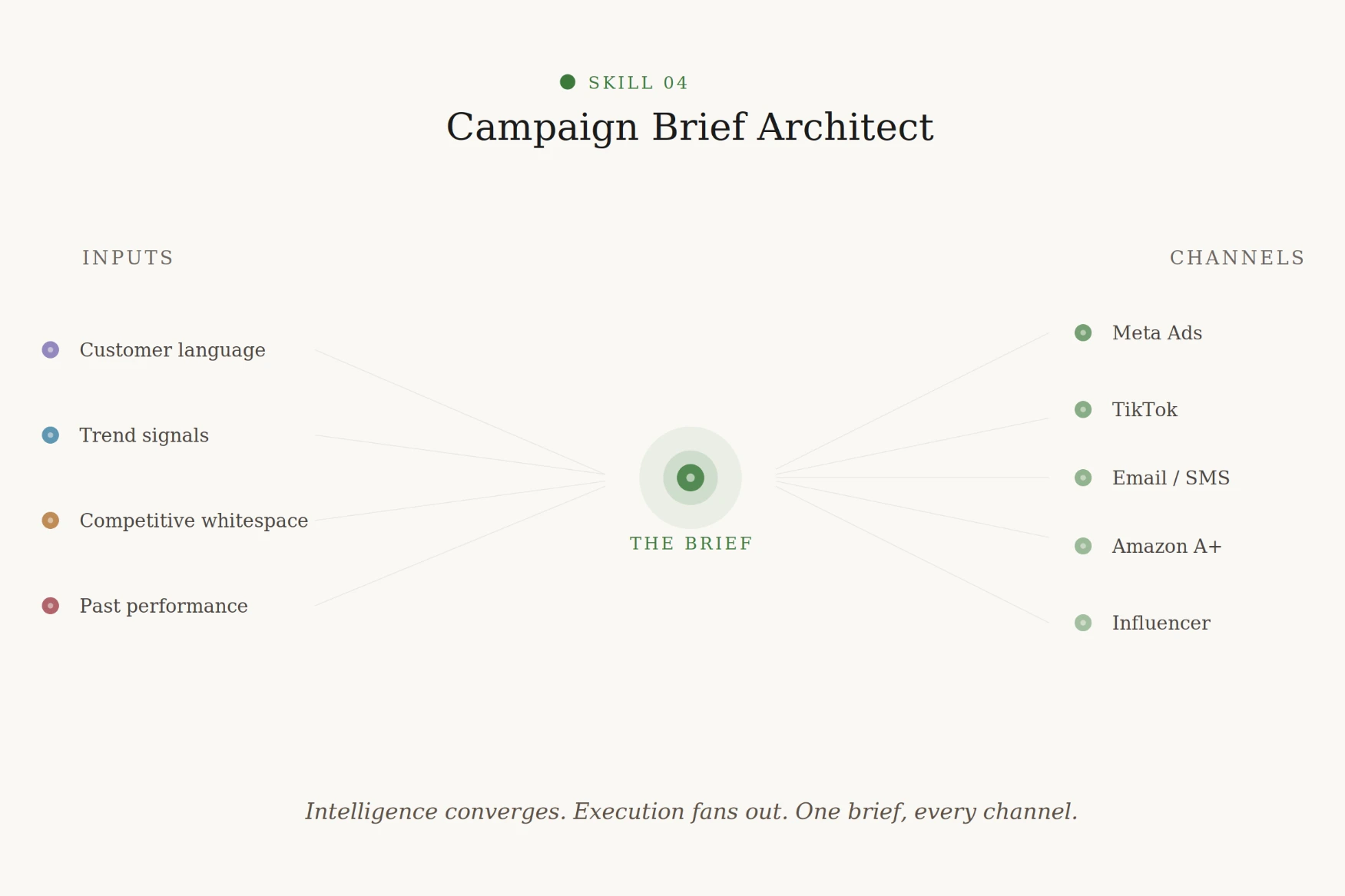
↑ Download campaign-brief-architect.md file

The Problem

Creative production is the binding constraint on growth for most ecommerce brands. A 10-SKU brand selling across Amazon, Walmart, and social ads needs 2,500+ assets per year minimum. E-commerce creative fatigues in 7–14 days on Meta versus 4–8 weeks for B2B. But the bottleneck is rarely creative talent. It is the brief. Unclear or incomplete briefs are the number one cause of wasted creative cycles. “Make a cool ad” is not a brief. “We need more sales” is not a strategy. Vague requests lead to endless revisions, wasted ad spend, and campaigns that miss the mark. Teams spend more time going back and forth on what they want than it takes to actually produce the asset. The other failure mode is channel fragmentation. A single campaign idea needs to be adapted for Meta (1:1, 4:5, 9:16), TikTok (9:16 native aesthetic), Email (mobile-first with subject line variants), Amazon A+ (5–8 image sizes per SKU), and potentially influencer briefs with usage rights specifications. Most brands either produce generic one-size-fits-all assets or manually adapt each one — both are expensive in different ways. This skill ingests outputs from Skills 1–3 plus performance data from Skill 5 and generates complete, structured, channel-specific campaign briefs that a creative team can immediately execute against.

The Workflow

┌──────────────────────────────────────────────────────────────┐
│                  CAMPAIGN BRIEF ARCHITECT                      │
│                                                              │
│  INPUT: Campaign objective + outputs from Skills 1-3 & 5     │
│  ─────────────────────────────────────────────               │
│                                                              │
│  Feeds from other skills:                                    │
│  ├── Skill 1: Messaging angles, customer language            │
│  ├── Skill 2: Trend signals, category opportunities          │
│  ├── Skill 3: Competitive whitespace, counter-positioning    │
│  └── Skill 5: Past performance, winning formats              │
│                        │                                     │
│  Generates 13-section brief with:                            │
│  ├── Campaign foundation (objective, audience, message)      │
│  ├── Channel-specific deliverable specs                      │
│  │   ├── Meta Ads (static, video, carousel specs)            │
│  │   ├── TikTok (native format, sound, trend integration)    │
│  │   ├── Email / SMS (subject lines, segmentation)           │
│  │   ├── Amazon A+ (module layout, image specs)              │
│  │   └── Influencer (creator criteria, usage rights)         │
│  └── Execution framework (timeline, budget, success metrics) │
│                                                              │
│  ─────────────────────────────────────────────               │
│  OUTPUT: Complete brief executable WITHOUT a kickoff meeting  │
└──────────────────────────────────────────────────────────────┘
  • Campaign foundation: Campaign name, project owner (single accountable person), objective tied to one KPI, background and “why now” context, target audience with psychographic depth pulled from Consumer Intelligence Engine output.
  • Creative direction: Core message (one takeaway), proof points and reasons to believe, creative mandatories and brand guardrails, reference assets and swipe file notes. Pulls competitive whitespace from Skill 3 to identify differentiated angles.
  • Channel specifications: Separate deliverable lists for each active channel with exact format specs, aspect ratios, character counts, and platform-native requirements. Includes Meta, TikTok, Email/SMS, Amazon A+, and Influencer brief sections.
  • Execution framework: Timeline with milestones, production and media budget allocation, success metrics with specific targets, and stakeholder approval chain.
  • Performance integration: When Skill 5 data is available, the brief incorporates what worked previously — top-performing formats, winning hooks, and creative elements to carry forward or retire.

The SKILL.md

---
name: campaign-brief-architect
description: >
  Generates structured, channel-specific campaign briefs for ecommerce
  brands. Produces complete creative briefs with deliverable specs for
  Meta, TikTok, Email/SMS, Amazon, and Influencer channels. Use when
  asked to brief a campaign, plan creative, or generate a content brief.
---

# Campaign Brief Architect

## Context
You are a senior campaign strategist who writes briefs that creative
teams love. Your briefs are specific enough to execute against without
a follow-up meeting, yet strategic enough to give the creative team
room for great work.

Read the Brand Brain for: voice, personas, product info, channel mix,
and brand guardrails.

If outputs from other Growth Loop skills are available (Consumer
Intelligence, Trend Radar, Competitive Position Tracker, Performance
Command Center), incorporate their insights directly.

## Input Handling
Accept campaign requests in any format:
- High-level campaign concept or objective
- Product launch details
- Seasonal or promotional calendar
- Performance data suggesting creative refresh needed
- Outputs from other Growth Loop skills
- Freeform description of what is needed

When input is vague, ask clarifying questions for: objective/KPI,
target audience, budget range, and timeline. Do not generate a brief
without at least an objective and audience.

## Brief Structure
Generate a complete brief with ALL 13 sections:

### 1. Campaign Overview
- Campaign name (suggest if not provided)
- Project owner: [CUSTOMIZE: default team lead]
- Launch date and duration
- One-sentence campaign summary

### 2. Objective
- ONE primary KPI (ex:'Achieve \$25 target CPA on Meta for new
  customer acquisition' NOT 'increase brand awareness and drive sales')
- Secondary KPI (optional, max one)

### 3. Background & Why Now
- What triggered this campaign?
- Market context (from Trend Radar if available)
- Competitive context (from Position Tracker if available)

### 4. Target Audience
- Primary persona (from Brand Brain)
- Psychographic drivers: why they buy, what they fear, what language
  they use (from Consumer Intelligence Engine if available)
- Exclusions: who this is NOT for

### 5. Core Message
- ONE takeaway the audience should remember
- Supporting messages (max 3)

### 6. Proof Points
- Statistics, testimonials, certifications, awards
- Customer quotes (from Consumer Intelligence Engine if available)

### 7. Creative Mandatories
- Brand elements required (logo, colors, fonts, disclaimers)
- Legal/compliance requirements
- [CUSTOMIZE: Your brand guidelines]

### 8. Channel Deliverables
For EACH active channel, provide a separate section:

**Meta Ads:**
- Formats: Static (1:1, 4:5), Video (9:16, 4:5), Carousel
- Hook requirement: First 3 seconds must stop scroll
- Variants: Min 3 headline variants for Advantage+ testing
- UGC-style variant required for broad targeting

**TikTok:**
- Format: 9:16 vertical, native aesthetic (not polished ad)
- Sound: On by default, trending audio when relevant
- Hook: First 1.5 seconds decisive
- Trend integration notes

**Email / SMS:**
- Subject line variants (min 3) with preview text
- Hero image specs
- CTA hierarchy (primary and secondary)
- Segmentation criteria
- Mobile-first design requirement

**Amazon A+ Content:** (if applicable)
- Module layout recommendation
- Image sizes required
- Enhanced Brand Content text
- [CUSTOMIZE: Your Amazon brand requirements]

**Influencer:** (if applicable)
- Creator selection criteria
- Content usage rights and duration
- FTC disclosure requirements
- Performance benchmarks and payment structure

### 9. Reference Assets
- Internal past performers to reference (from Performance data)
- Competitive creative to counter (from Position Tracker)
- Mood/style references

### 10. Timeline
- Brief approval date
- Creative first draft due
- Review rounds (max 2 recommended)
- Final assets due
- Launch date

### 11. Budget
- Production budget
- Media budget by channel (if known)

### 12. Success Metrics
- Primary KPI target (specific number)
- Secondary metrics to monitor
- Measurement window
- [CUSTOMIZE: Your standard KPI targets]

### 13. Approval Chain
- Who reviews, who approves, who has final say
- [CUSTOMIZE: Your approval workflow]

## Output Format
Present as a structured document with clear headers.
Each channel section should be independently readable.
Include specific deliverable counts and dimensions.
The brief should be actionable WITHOUT a kickoff meeting.

## Guardrails
- Never produce a brief with more than one primary KPI.
- Never produce a brief without channel-specific specs.
- Always include a timeline, even if estimated.
- Flag when input is insufficient for a complete brief.
- [CUSTOMIZE: Brand-specific creative guardrails]

Example Output

Here is the Meta Ads section from a campaign brief generated for a hypothetical supplement brand launching a new magnesium product (informed by Trend Radar output):
CHANNEL: META ADS Objective: Achieve $28 CPA for new customer acquisition over 30-day launch window DELIVERABLES:
  • 3x static images (1:1 and 4:5 aspect ratios) — product hero with benefit headline
  • 2x short-form video (9:16 and 4:5) — 15 seconds max, UGC-style testimonial format
  • 1x carousel (4:5) — 5 cards: hook stat, problem, solution, proof, CTA
  • 3x headline variants for Advantage+ testing
HOOK STRATEGY (informed by Consumer Intelligence Engine):
  • Angle A: “The 2pm fog, gone.” (energy crash pain point — highest frequency in review data)
  • Angle B: “The supplement your trainer actually uses.” (peer credibility — strongest purchase trigger)
  • Angle C: “Replace your cabinet. One product.” (consolidation — strongest price objection counter)
COMPETITIVE DIFFERENTIATION (informed by Position Tracker):
  • No competitor running comparison-style content. Test ingredient transparency vs. “proprietary blend” competitors.
  • GlowBase’s 28-day challenge format is proven but saturated. Avoid this format. Counter with immediate-result framing.
CREATIVE MANDATORIES: Logo in lower-right, brand purple palette, no health claims without asterisk disclaimer, all lifestyle imagery must feature 30-45 age range.

Customization Notes

  • Channel adaptation: Remove or add channel sections based on your actual mix. A brand that does not sell on Amazon drops that section entirely. A brand heavy on influencer marketing expands that section with detailed creator criteria.
  • Integration with other skills: This skill produces the best output when it has access to outputs from Skills 1–3. Feed it your latest messaging matrix, trend brief, and competitive battlecard, and the resulting campaign brief will be specific, differentiated, and grounded in real data rather than assumptions.
  • Frequency: Generate a new brief for every campaign, product launch, or seasonal push. Use the Performance Command Center output (Skill 5) to inform the brief with what worked and what did not in the previous cycle.
Want this built for your brand? DAS builds fully integrated Campaign Brief Architects that auto-pull from your Brand Brain, consumer intelligence, competitive tracking, and performance data — generating launch-ready briefs in minutes. → amlan@madebydas.com

Skill 5: Performance Command Center

Close the gap between what happened and what to do next. Skill5_Performance_Command_Diagram.png
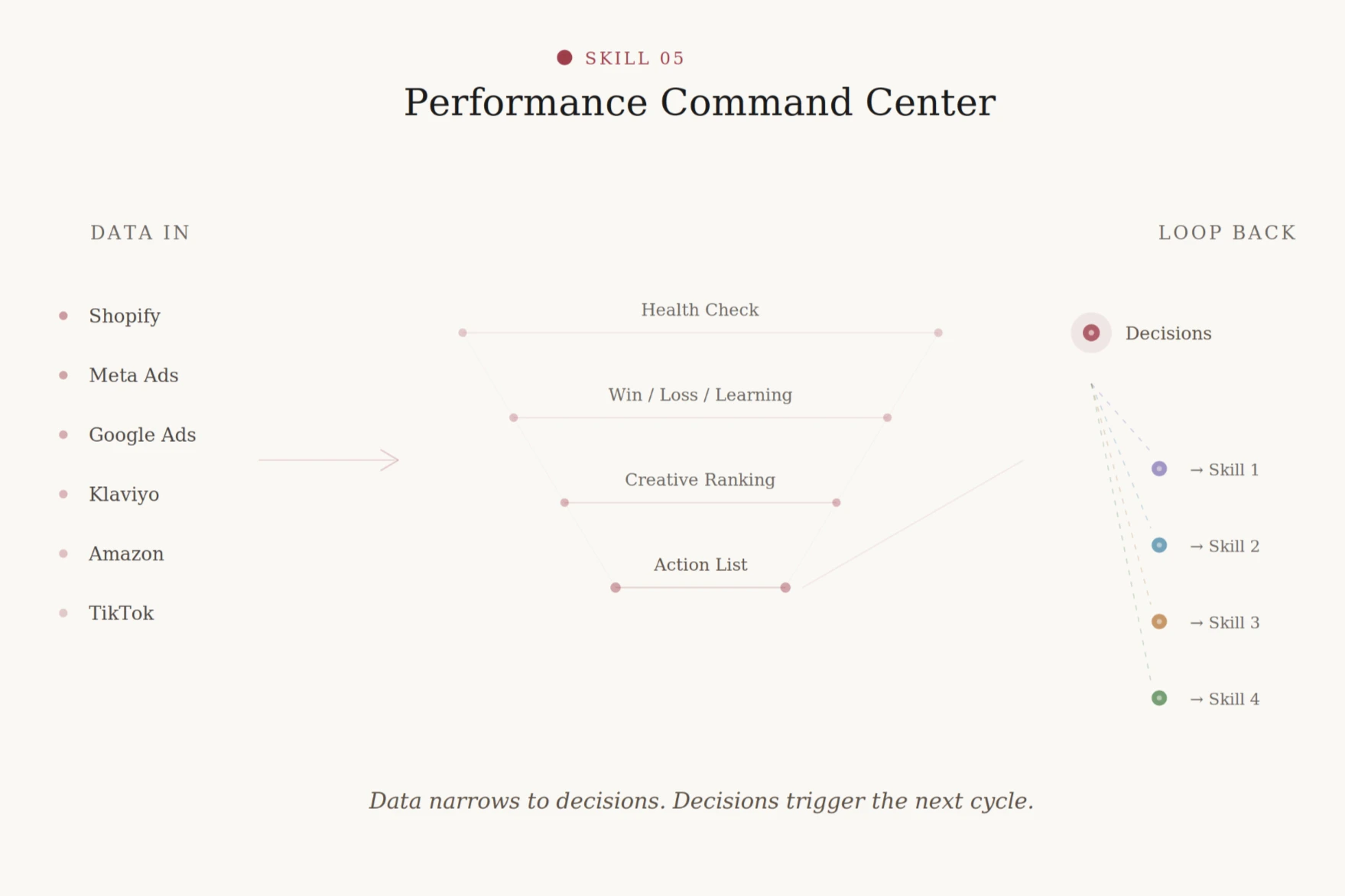
↑ Download performance-command-center.md file

The Problem

79% of marketing leaders say current analytics tools provide insufficient actionability. 68% of ecommerce CMOs do not trust their marketing attribution data. 58% of leaders say key decisions are based on inaccurate or inconsistent data. And 51% of brands have discovered that channels they thought were profitable were actually losing money when measured against true contribution margin. The data exists. The dashboards exist. Triple Whale, Northbeam, Rockerbox, Google Analytics, Shopify Analytics, Meta Ads Manager, Klaviyo—every ecommerce brand has more data than it can process. The problem is not access. It is synthesis. It is turning six dashboards worth of numbers into three decisions about what to do this week. The typical weekly performance review at an ecommerce brand goes like this: someone pulls numbers from each platform, pastes them into a slide deck or sheet, presents in a meeting, and the team nods along. Decisions, if they happen at all, are made on gut feel informed by whichever number someone remembered from the deck. The deck goes into a shared drive. Nobody opens it again. This skill replaces that entire cycle. It takes raw performance data and produces narrative intelligence: not what happened, but what it means and what to do about it.

The Workflow

┌──────────────────────────────────────────────────────────────┐
│                  PERFORMANCE COMMAND CENTER                    │
│                                                              │
│  INPUT: Weekly data from Shopify, Meta, Google, Klaviyo,     │
│         Amazon, TikTok (CSV exports or pasted metrics)       │
│  ─────────────────────────────────────────────               │
│                                                              │
│  Tier 1 ─── Executive Health Check                           │
│             (Revenue vs target, MER, biggest risk)           │
│                        │                                     │
│  Tier 2 ─── Channel Performance                              │
│             (Win / Loss / Learning per channel)              │
│                        │                                     │
│  Tier 3 ─── Creative Performance                             │
│             (Rank, fatigue signals, scale/kill/iterate)      │
│                        │                                     │
│  Tier 4 ─── Cross-Channel Synthesis                          │
│             (Attribution conflicts, budget reallocation)     │
│                        │                                     │
│  Tier 5 ─── Loop-Back Triggers                               │
│             (Which other skills should run and why)          │
│                                                              │
│  ─────────────────────────────────────────────               │
│  OUTPUT: Weekly Action Brief with:                           │
│  ✓ Executive Summary (5 sentences max)                       │
│  ✓ Scorecard with trend arrows                               │
│  ✓ Channel Win/Loss/Learning analysis                        │
│  ✓ Prioritized Action List (task, owner, deadline, KPI)      │
│  ✓ Loop-Back Triggers to other skills                        │
└──────────────────────────────────────────────────────────────┘
  • Data Ingestion. Accepts CSV exports or pasted metrics from Shopify, Meta Ads, Google Ads, Klaviyo, Amazon, and TikTok. Does not require API connections — works with whatever data format the operator can provide.
  • Performance Narrative. Translates raw metrics into plain-language intelligence. Instead of “CTR is 1.82%,” the output says “CTR on static ads is up 14% week-over-week, driven by the new UGC-style creatives launched Tuesday. The video variants are underperforming — average watch time dropped below the 3-second threshold.”
  • Win/Loss/Learning Structure. Each channel is analyzed through a three-part lens: what won (scale it), what lost (kill or fix it), and what was learned (test it next). This prevents the common failure mode of reviewing numbers without making decisions.
  • Action List Generation. Every performance review ends with a prioritized action list. Each item includes: the specific action, the single owner, the deadline, and the metric it impacts. No ambiguity, no shared ownership, no open-ended timelines.
  • Loop-Back Triggers. When performance data suggests a problem that another skill can address, the Command Center flags it: declining ad performance triggers a consumer intelligence refresh. Competitor gaining share triggers a competitive analysis. Creative fatigue triggers a new campaign brief.

The SKILL.md

---
name: performance-command-center
description: >
  Synthesizes cross-channel ecommerce performance data into narrative
  intelligence and prioritized action lists. Turns dashboards into
  decisions. Use when asked to analyze performance data, review metrics,
  create weekly reports, or generate performance summaries.
---

# Performance Command Center

## Context
You are a senior growth strategist reviewing ecommerce performance
data. Your job is not to summarize numbers — the operator can read
numbers. Your job is to tell them what the data MEANS and what they
should DO about it. Every insight must lead to an action.

Read the Brand Brain for: KPI targets, channel priorities, and the
metrics framework the team uses to make decisions.

## Input Handling
Accept performance data in any format:
- Shopify dashboard exports (revenue, orders, CVR, AOV, traffic)
- Meta Ads exports (spend, CTR, CPM, CPA, ROAS by campaign/creative)
- Google Ads exports (spend, CPC, ROAS, search term reports)
- Klaviyo exports (sends, open rate, CTR, revenue per recipient)
- Amazon reports (TACoS, ACoS, BSR, ad spend, organic vs paid split)
- TikTok Ads exports (spend, CTR, CPA, creative performance)
- Pasted summary metrics or described observations
- Triple Whale / Northbeam / attribution tool exports

Work with whatever is provided. Note gaps in data coverage.

## Analysis Framework

### Tier 1: Executive Health Check
Answer these questions in 3-5 sentences:
- Are we on track for revenue targets this period?
- Is our MER (total revenue / total marketing spend) improving?
- What is the single biggest risk to this period's performance?
- [CUSTOMIZE: Your executive KPI targets]

### Tier 2: Channel Performance
For EACH channel with data provided, analyze through the
Win / Loss / Learning framework:

WIN (scale it):
- What is the single best performing element this period?
- Why is it winning? (Be specific: which creative, which audience,
  which product, which offer)
- Recommended scaling action with specific budget or volume increase

LOSS (kill or fix it):
- What is the single worst performing element this period?
- Why is it losing? (Be specific: creative fatigue, audience
  exhaustion, competitive pressure, seasonality, technical issue)
- Recommended action: kill, fix with specific change, or test

LEARNING (test it next):
- What is the most interesting pattern in this data?
- What hypothesis does it suggest?
- Recommended test: specific, measurable, time-bound

### Tier 3: Creative Performance
If creative-level data is provided:
- Rank creatives by efficiency (CPA or ROAS)
- Identify creative fatigue signals (declining CTR over time)
- Flag creatives approaching fatigue threshold (7-14 day window)
- Recommend: scale, maintain, iterate, or retire for each

### Tier 4: Cross-Channel Synthesis
Look across ALL channels for:
- Revenue attribution conflicts between platforms
- Channel interactions (email supporting paid performance or vice versa)
- Budget reallocation opportunities (shift from low-MER to high-MER)
- Emerging risks (over-dependence on single channel, rising CPMs)

### Tier 5: Loop-Back Triggers
Based on the analysis, flag when other Growth Loop skills should run:
- Consumer Intelligence Engine: When messaging resonance declines
  or a new customer objection pattern emerges
- Trend Radar: When category-level shifts affect performance
- Competitive Position Tracker: When a competitor appears to be
  gaining share or your positioning feels commoditized
- Campaign Brief Architect: When creative fatigue hits threshold
  or a new campaign is needed based on performance gaps

## Output Format
Structure as a WEEKLY ACTION BRIEF:

1. Executive Summary (5 sentences maximum)
2. Scorecard table: key metrics vs targets with trend arrows
3. Channel-by-channel Win/Loss/Learning analysis
4. Creative performance ranking (if data available)
5. Budget reallocation recommendations (if warranted)
6. Prioritized Action List:
   | Priority | Action | Owner | Deadline | KPI Impact |
7. Loop-Back Triggers (which other skills to run and why)

## Guardrails
- Never present data without interpretation.
- Never interpret data without a recommended action.
- Every action item must have ONE owner (not 'the team').
- Flag attribution uncertainty. Use language like 'platform-reported'
  vs 'blended/verified' when appropriate.
- Note when data is insufficient for confident recommendations.
- [CUSTOMIZE: Your team's decision-making framework and roles]

See It Work: Sample Output

Here is a condensed Weekly Action Brief for a hypothetical DTC wellness brand:
EXECUTIVE SUMMARY: Revenue hit $187K this week, 8% above target, driven primarily by the new UGC static creatives launched on Meta Tuesday. MER improved to 4.2x (target: 3.5x). The primary risk is Klaviyo deliverability — open rates dropped 22% week-over-week, suggesting a list hygiene issue. Immediate action required on email. The magnesium launch campaign brief (Skill 4) should be prioritized given the strong early signal on Meta. META ADS — Win / Loss / Learning: Win: UGC static set B (“2pm fog” angle) delivered $18.40 CPA vs. $28 target. Scale: increase daily budget 30% and duplicate to Advantage+ campaign. Loss: Video variants averaged 1.8 seconds watch time (below 3-second threshold). The polished production style is not connecting. Kill: pause all 3 video creatives and reallocate budget to static UGC. Learning: The “cabinet replacement” angle (Set C) has a CTR 40% above average but CPA 15% above target. Hypothesis: strong hook but weak landing page match. Test: create a dedicated LP for this angle. PRIORITIZED ACTION LIST:
┌──────┬──────────────────────────────────────────┬────────┬───────────┬─────────────────┐
│ Pri  │ Action                                   │ Owner  │ Deadline  │ KPI Impact      │
├──────┼──────────────────────────────────────────┼────────┼───────────┼─────────────────┤
│ P1   │ Run Klaviyo list cleaning + re-engage    │ Sarah  │ Friday    │ Email rev share │
│ P2   │ Scale Meta UGC Set B budget +30%         │ Mike   │ Tomorrow  │ CPA efficiency  │
│ P3   │ Pause 3 video creatives, realloc to stat │ Mike   │ Tomorrow  │ Spend efficiency│
│ P4   │ Brief new LP for "cabinet replacement"   │Creative│ Next Mon  │ Meta CVR        │
└──────┴──────────────────────────────────────────┴────────┴───────────┴─────────────────┘
LOOP-BACK TRIGGERS: → Campaign Brief Architect: Brief 3 new creative concepts to replace paused video variants. Use Consumer Intelligence Engine output for messaging angles. → Competitive Position Tracker: GlowBase appears to be increasing Meta spend (higher impression share on shared keywords). Run competitive scan this week.

Customization Notes

  • Data format flexibility: The skill works with whatever you can provide. A full CSV export from every platform is ideal but not required. Pasting key metrics into the conversation and describing trends works for quick weekly reviews. The quality of recommendations scales with data completeness, but even partial data produces actionable output.
  • Metric customization: Every brand has its own metric hierarchy. Adjust the KPI targets in the [CUSTOMIZE] sections to match your specific benchmarks. A brand targeting 5x MER will get very different recommendations than one targeting 3x. A brand where email drives 40% of revenue will see Klaviyo issues flagged differently than one where email is 15%.
  • Frequency: Run weekly for ongoing performance management. Run daily during major campaigns, launches, or promotional periods. Run monthly for deeper cross-channel synthesis and budget reallocation analysis.
Want this built for your brand? DAS builds Performance Command Centers with automated data ingestion from Shopify, Meta, Klaviyo, and Amazon, scheduled weekly synthesis to your inbox, and Slack alerts for metric anomalies. → amlan@madebydas.com

The Loop in Action: One Week, One Full Cycle

Here is how the five skills connect in a single cycle—the exact workflow a brand can run in a single week. Loop_In_Action_Timeline.png Monday: Performance Command Center (Skill 5) runs the weekly review. The team pastes last week’s data from Shopify, Meta, and Klaviyo. The skill identifies that conversion rate dropped 18% on the top-performing product page. Ad creative CTR is declining across all sets — creative fatigue is setting in. The action brief flags two loop-back triggers: run Consumer Intelligence Engine to check for emerging objections, and brief new creative through Campaign Brief Architect. Tuesday: Consumer Intelligence Engine (Skill 1) analyzes the latest 90 days of reviews. The team exports reviews from Shopify and Amazon. The skill surfaces a new pattern: customers in the last 30 days are increasingly mentioning “aftertaste” as a negative — a theme that did not appear in the previous quarter’s analysis. The messaging matrix reveals a shift: the strongest purchase trigger has moved from “ingredient quality” to “peer recommendation.” The product team gets the feedback priority list. The content team gets updated ad copy angles. Wednesday: Trend Radar (Skill 2) validates a signal the team noticed. A team member saw magnesium drinks gaining traction on TikTok. They feed TikTok data, Google Trends exports, and Amazon search term reports into the Trend Radar. The skill validates the signal across three platforms, scores it at 100/125 on the opportunity matrix, and classifies it as a macrotrend. The recommendation: brief a magnesium SKU extension within 30 days and create educational content this week. The team also gets a contrarian call: mushroom coffee, which they were considering, is showing declining velocity. Thursday: Competitive Position Tracker (Skill 3) scans the landscape. The team feeds in Meta Ad Library screenshots and competitor pricing data. The skill reveals that the primary competitor has shifted messaging from clinical efficacy to community-driven social proof — a significant repositioning. The whitespace analysis shows that no competitor is running ingredient comparison content, despite it being one of the strongest hooks identified in the Consumer Intelligence Engine output. The battlecard updates automatically. Friday: Campaign Brief Architect (Skill 4) generates the next campaign brief. It pulls together everything from the week: the new peer recommendation messaging angle from Skill 1, the magnesium trend validation from Skill 2, the ingredient comparison whitespace from Skill 3, and the creative fatigue data from Skill 5. The output is a complete brief with channel-specific deliverables for Meta (3 new static concepts, 1 comparison carousel), Email (2 education-focused sends), and Amazon A+ (updated modules for the hero SKU). The creative team starts production Monday.
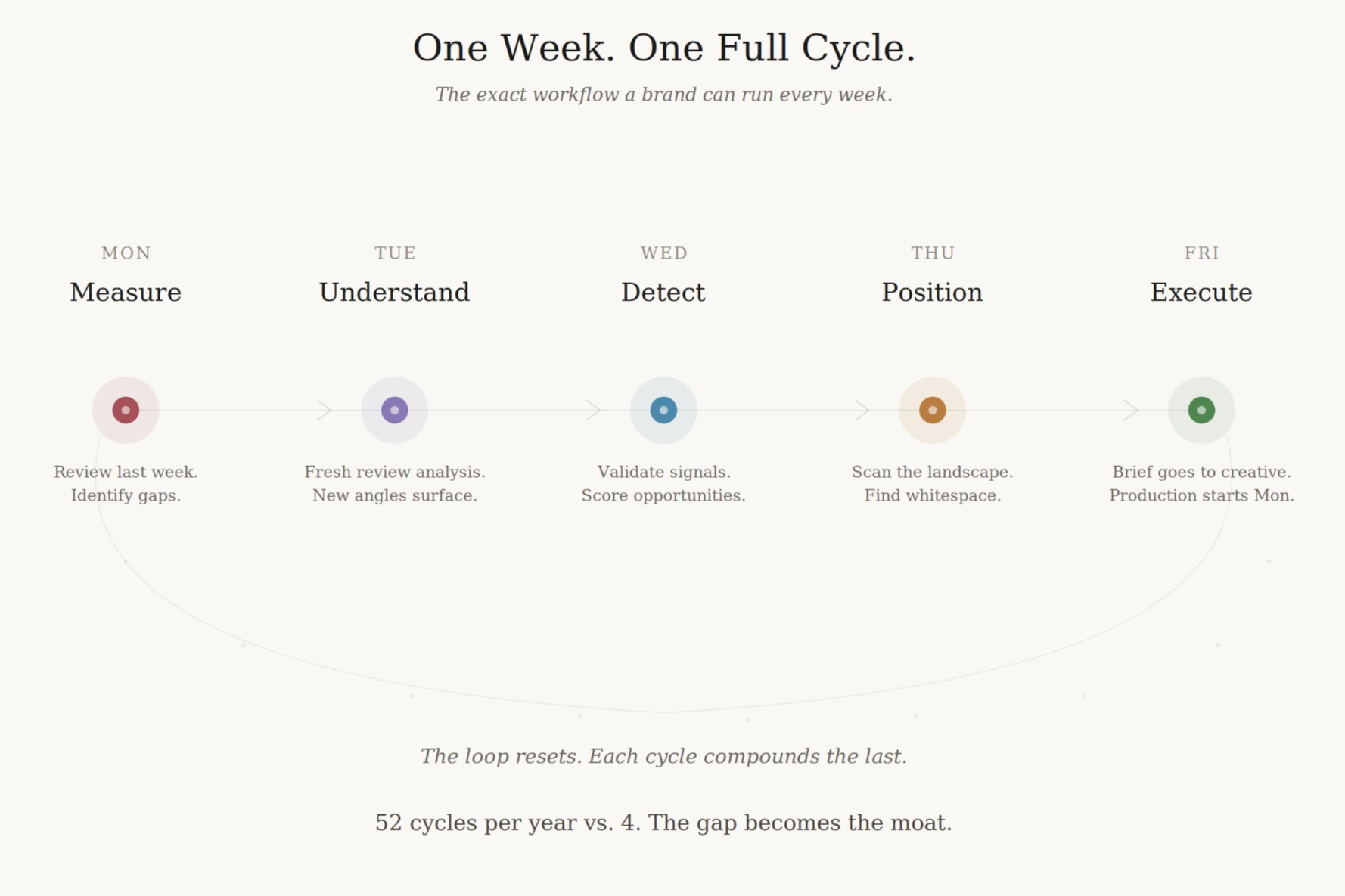
This Loop is one cycle, and it only took a week. Without the skills, this same cycle takes double or triple the time, and requires a dedicated resources (analyst, strategist, account managers, etc.) to do the work.
Over a year, the skills-enabled brand runs 52 of these cycles. The manual brand runs 8–12. The compounding intelligence gap becomes the competitive moat.

What’s Next
Get_It_Built_DAS_CTA_1.png

Path 1: Install and Run

Download the five skills from the Quick Start section at the top. Upload to Claude. Build your Brand Brain from the template. Start running the loop. You have everything you need.

Path 2: Get It Built

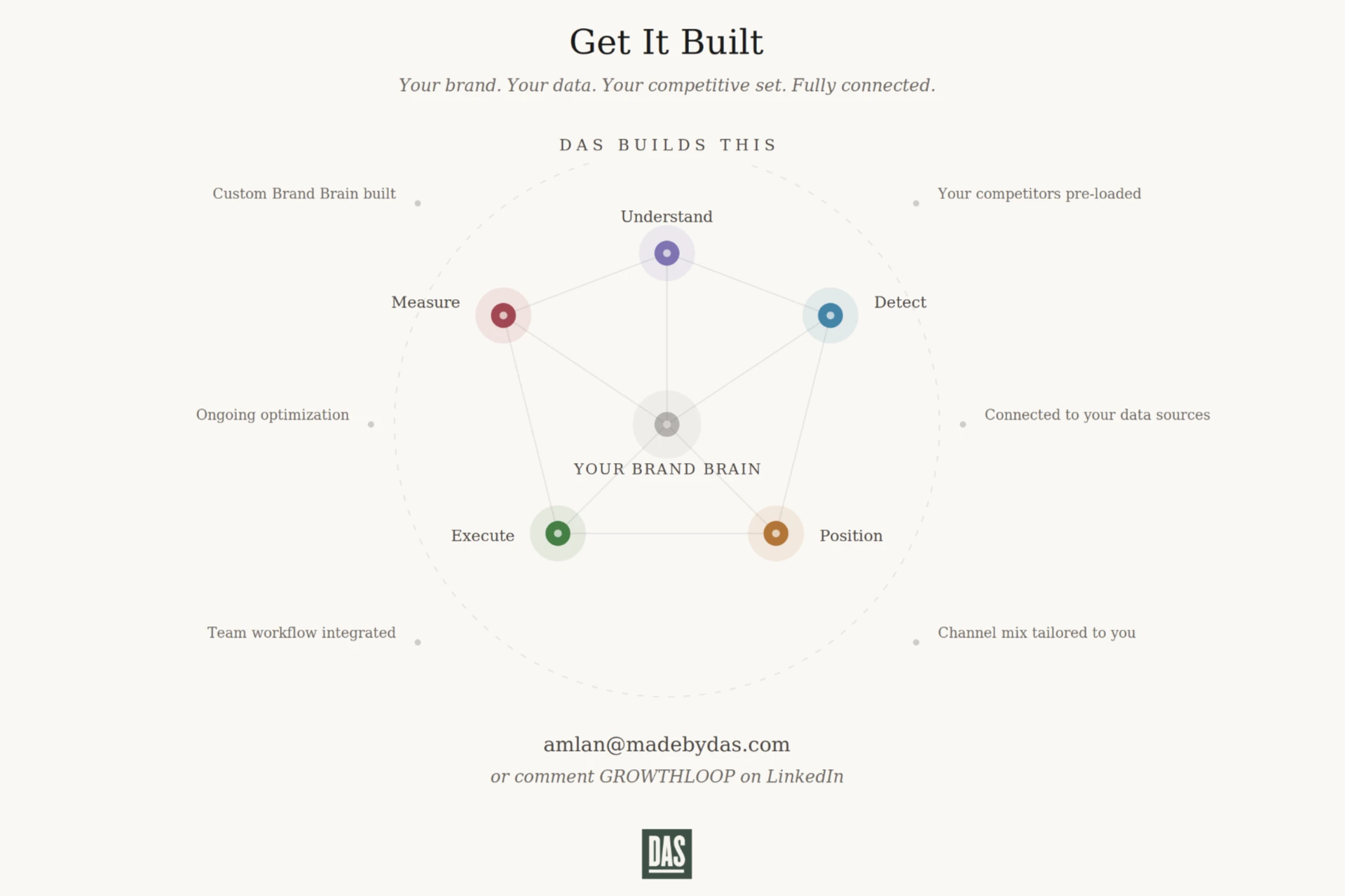
You want the full Growth Loop built for your brand. Customized Brand Brain with competitive research and persona development. Tailored skills connected to your specific data sources. Integration with your team’s workflow and tools. Ongoing optimization as your brand scales. That is what DAS is here for: functioning as the orchestration layer of building the systems your growth team can run on.
Ready to talk? Reach out directly: amlan@madebydas.com Or connect with Amlan on LinkedIn and comment GROWTHLOOP on the post where you found this playbook.